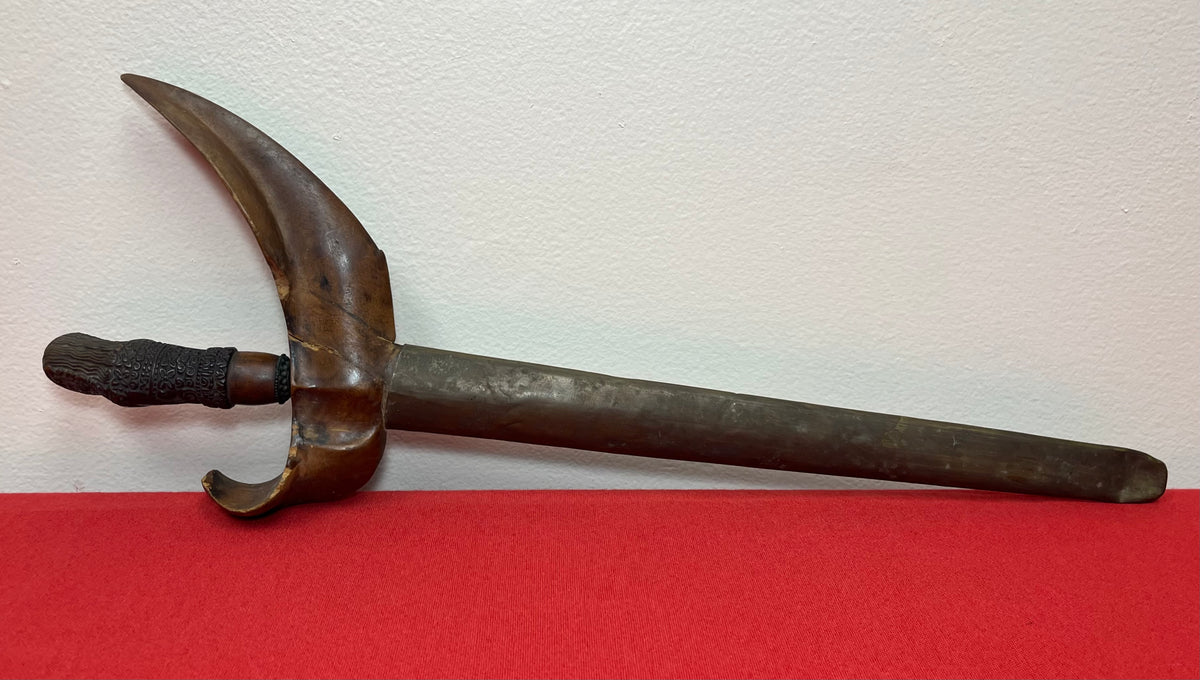
Original Indonesian East Indies Kris Dagger Circa 1850
The kris or keris is a prized asymmetrical dagger most strongly associated with the culture of Indonesia, but also indigenous to Malaysia, Thailand, Brunei and Singapore. It is known as kalis in the southern Philippines. The kris is famous for its distinctive wavy blade.
A kris can be divided into three parts: bilah (blade), hulu (hilt), and warangka (sheath). These parts of the kris are objects of art, often carved in meticulous detail and made from various materials: metal, precious or rare types of wood, or gold or ivory. A kris's aesthetic value covers the dhapur (the form and design of the blade, with around 150 variants), the pamor (the pattern of metal alloy decoration on the blade, with around 60 variants), and tangguh referring to the age and origin of a kris.
Both a weapon and spiritual object, kris are often considered to have an essence or presence, considered to possess magical powers, with some blades possessing good luck and others possessing bad. Kris are used for display, as talismans with magical powers, weapons, a sanctified heirloom (pusaka), auxiliary equipment for court soldiers, an accessory for ceremonial dress, an indicator of social status, a symbol of heroism, etc. Legendary kris that possess supernatural power and extraordinary ability were mentioned in traditional folktales, such as those of Mpu Gandring, Taming Sari, and Setan Kober.
This example is not a modern tourist item, it is the real thing dating from the mid 19th century, in fact the exceptional blade may date as much earlier.
This is a most ornate example clearly having belonged to someone of importance, the nearly 13" blade (bilah) has the traditional Kris snake like design. However, the finest feature is that the blade has been hammered together both regular mined iron and meteor-iron which has a high nickel content resulting is a most attractive mottled finish showing the grain of the combined metals that have been hot forged into steel. This is known as the pamor.
The key to identify the older blades is to be able to find the join at the hilt end of the blade as the horn was always added as a separate piece. Later examples and modern tourist pieces were always had blades made from just one sheet of steel. This example definitely has the separate hilt end of the blade, which is then brazed or welded on.
Each section of the Dutch East Indies produced the traditional Kris Daggers but each district, Java, Borneo, and others had their own characteristics. This area is today covered by what we know as Indonesia, Malaya and the Phillipines.
Overall Size - 19.50 Inches / Blade 12.50 Inches / Handle 4.25 Inches /
Condition:
There are two stress cracks to the wooden “throat” of the scabbard, on the (reverse side) that are non-structural, but visible.